Lighting projects rarely succeed when a fixture is selected before the space is understood. For offices, libraries, classrooms, galleries, and other commercial interiors, we begin by reviewing the task, ceiling condition, visual environment, controls, and installation method. Our approach to a linear light fixture therefore considers the whole lighting system rather than appearance alone. This helps balance comfort, flexibility, efficiency, and installation.
Start with the Space and Lighting Task
Every project begins with the space. Workstations, circulation routes, meeting areas, display surfaces, and teaching zones can require different distributions. Office writing, reading, and data-processing areas, for example, are commonly designed around 500 lux under European workplace guidance, while the level depends on the activity and applicable standard. We treat the lighting target as a design input rather than assuming one output suits every room.
Glare also needs attention early. UGR is not simply a fixed characteristic of a luminaire; it depends on the fixture, room geometry, surface reflectance, and observer position. For office work, UGR below 19 is a commonly referenced target under EN 12464-1. We consider optic selection and luminaire positioning together so the layout can support comfortable screen-based work.
Match the Fixture to the Ceiling and Layout
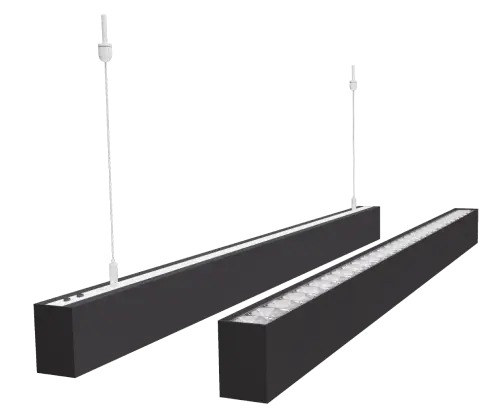
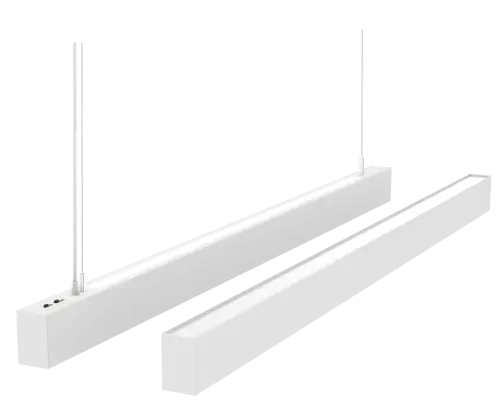
Installation conditions strongly influence the specification. Surface mounting can suit spaces where ceiling structure or available depth limits suspension. Suspended LED office lighting can place light at an appropriate level and contribute to a layered architectural composition. The U.S. Department of Energy recognizes suspended linear ambient luminaires for commercial LED applications.
Our Elite Series gives project teams surface-mounted and suspension options. Four sizes and wattages from 30W to 60W allow the specification to respond to different room dimensions and lighting requirements. Rather than forcing one standard configuration across every project, we can select a format that works with the ceiling, furniture plan, and visual rhythm of the interior.
Use Optics to Shape Visual Comfort
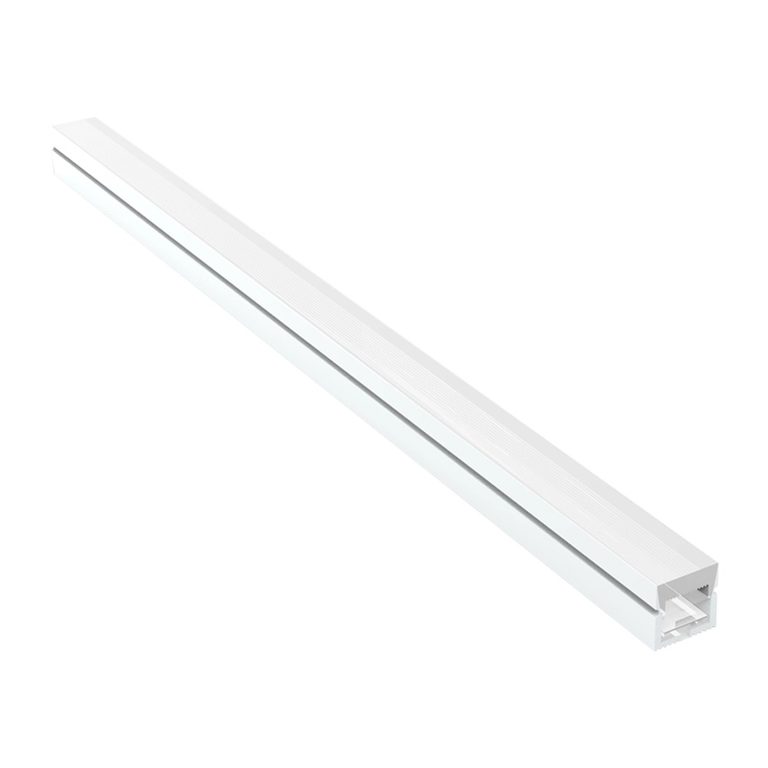
Optics are another important project decision. A diffuser can affect luminance, distribution, and the visual character of a continuous linear installation. For the Elite Series, we offer two optic choices: a PC diffuser and a PMMA microprism option. The selection depends on the project’s photometric design.
This matters where screens, polished surfaces, or long sightlines are present. Office lighting guidance emphasizes the relationship between luminaire placement and reflected glare. At LEDIA Lighting, we therefore recommend evaluating the optic with mounting height, spacing, viewing direction, and room finishes instead of judging a linear light fixture from its appearance alone.
Build Flexibility into Controls
Commercial projects increasingly require lighting that can adapt to occupancy, daylight, task changes, or user preferences. The Department of Energy notes that LED luminaires can work with occupancy sensing, task tuning, and dimming. Controls can therefore be part of the initial specification rather than an afterthought.
For our Elite Series, we support On/Off, 0–10V dimming, and DALI dimming configurations. The series also provides a changeable CCT, with a slider switch allowing users to adjust the CCT and separately change the up or down light. This gives project teams more control.
Balance Direct and Indirect Light
A commercial interior does not depend only on light reaching the workplane. Ceiling brightness and vertical illumination can influence how a room feels, while excessive direct output can create uncomfortable contrast or reflections. Direct/indirect linear lighting is useful when the design calls for functional illumination and a balanced luminous environment.
The Elite Series incorporates up and down light to support this approach. We can use the distribution as part of the ceiling and furniture strategy, rather than treating it as an isolated object. This is relevant to offices, classrooms, libraries, and galleries.
Plan Connectivity and Installation
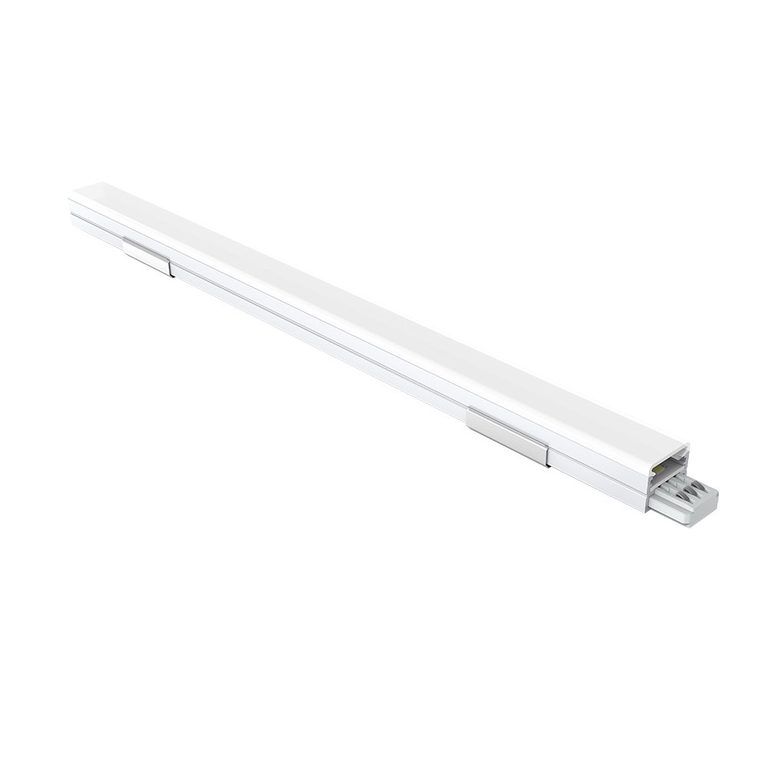
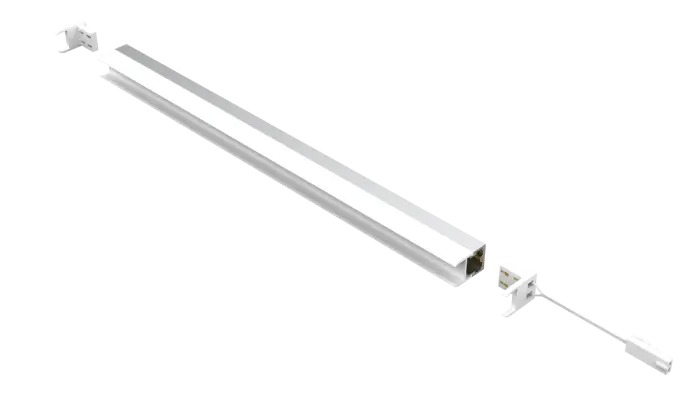
Project efficiency also depends on how easily fixtures can be arranged and connected. Long linear runs may need different lengths, junctions, or layouts depending on room dimensions and architectural features. Selecting a system with compatible connectors can simplify planning and help create continuous visual lines without unnecessary changes.
We design the Elite Series with different connectors so the linear lights can be linked freely. This supports adaptable layouts when translating a lighting concept into an installation plan. Combined with surface or suspended mounting, the same family can respond to varied architectural conditions while maintaining design consistency.
Specify for the Whole Project, Not Just the Fixture
A successful lighting specification connects photometric performance, mounting, controls, optics, connectivity, and maintenance expectations. Energy efficiency is also worth reviewing at procurement; DOE guidance for commercial LED luminaires highlights efficacy, controls compatibility, and quality-performance criteria as important purchasing considerations.
Our role is to work through these factors with project requirements in view. The Elite Series suits offices and public scenarios where flexible sizing, two optic choices, adjustable CCT, up/down illumination, controls, and different installation methods simplify specification. We apply the same project-led thinking when evaluating a linear light fixture.
Turning Project Requirements into a Practical Lighting Solution
A well-designed lighting project starts with the room, not a catalog page. By assessing visual tasks, glare, mounting conditions, optics, controls, connectivity, and layout together, we can help project teams develop lighting that is functional and architecturally coherent. For projects requiring adaptable suspended LED office lighting, the Elite Series combines suspension capability with up/down illumination, changeable CCT, dimming options, and flexible linking. We can also consider suspended LED office lighting when ceiling coordination and visual zoning make pendant mounting preferable.