



-
Recessed Lighting Spacing for Kitchens and Living Rooms
Master the perfect recessed lighting layout. Learn how to space ceiling lights in your kitchen and living room to eliminate shadows and create the ideal ambiance.Read more -
4-Inch vs. 6-Inch Recessed Lighting: How to Choose the Right Size for Your Ceiling
Deciding between 4-inch and 6-inch recessed lights? Discover the best size for your ceiling height, room style, and lighting goals in this comprehensive guide.Read more -
2026 Lighting Power Density: Energy Code Compliance Path, Energy Codes (with LPD Calculator & 2026 Section 179 Calculator)
The latest 2026 Lighting Power Density (LPD) requirements. A comprehensive guide to energy codes for sustainable commercial lighting.Read more
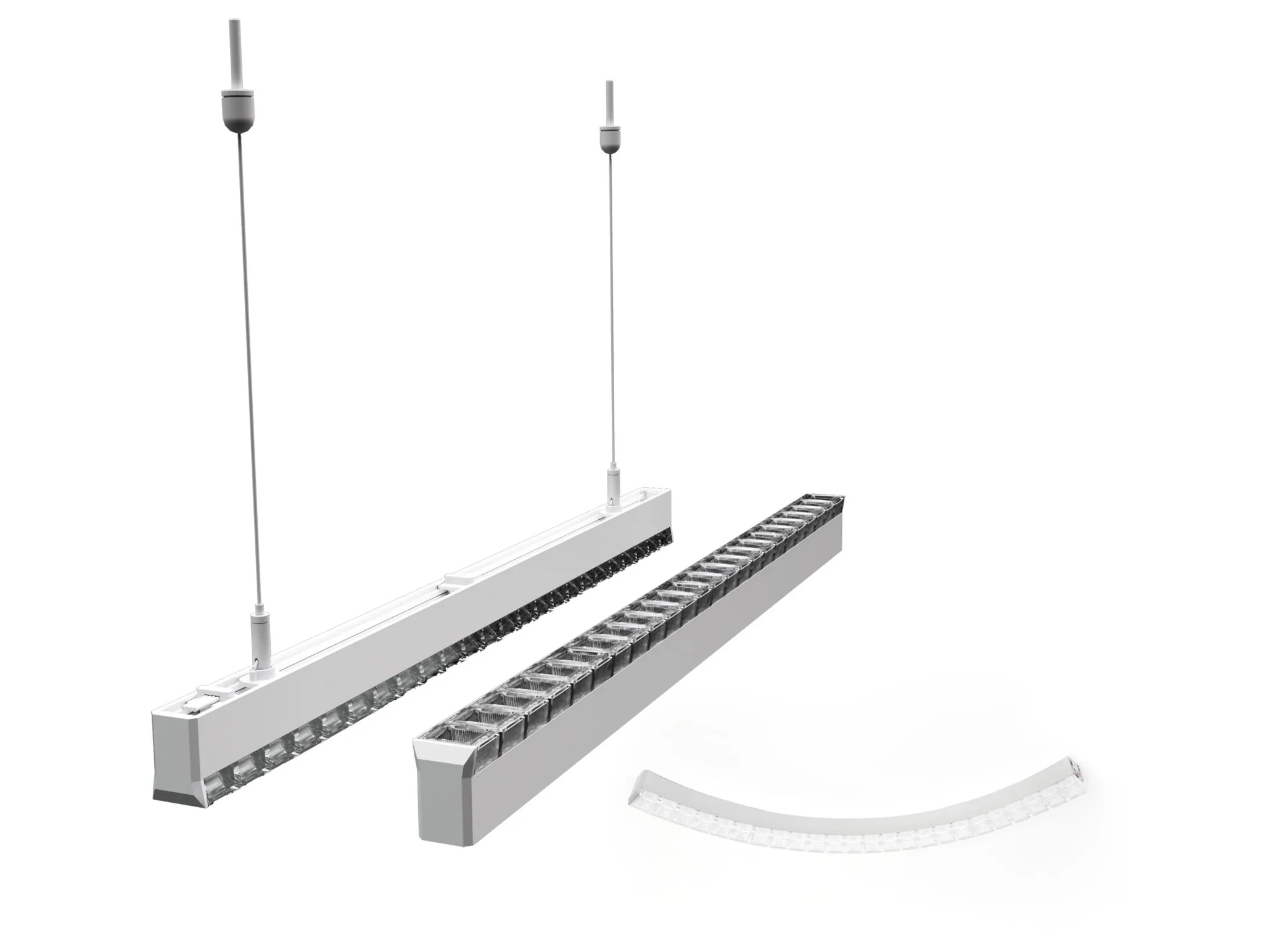
Architecting Light: The Precision of LED Fixture Optics
- 21 Jun 2024
An LED fixture’s ability to shape and direct light is not a matter of chance but of calculated optical design. This engineered system works like a lens on a camera, meticulously managing the raw output from diodes to create specific illumination patterns. We consider this optical architecture a core aspect of our development process for professional fixture LED lighting. The right design ensures visual comfort, enhances task performance, and contributes to the overall energy efficiency of an installation by placing light only where it is required.

The Strategic Application of Reflector Geometry
Reflectors serve as the first line of control in managing light from an LED source. Their function is based on precise geometric shapes—parabolic, elliptical, or custom free-form designs—that capture and redirect light rays. A parabolic shape, for instance, can collimate light into a focused beam, while a wide elliptical reflector may create a soft, widespread distribution. The material finish, whether a specular or diffuse reflection, further influences the beam’s character. For an LED lighting manufacturer, selecting the correct reflector geometry is a fundamental decision that defines the base layer of light control for a fixture.
The Definitive Control Offered by Optical Lenses
For applications demanding sharpness and accuracy, optical lenses provide superior control over light distribution. These components, typically crafted from PMMA or polycarbonate, use the principles of refraction—often through Total Internal Reflection (TIR) technology—to gather a wide cone of light and shape it into a defined beam. This process allows for the creation of consistent beam angles with clean cutoffs, which is essential for accent lighting, retail highlighting, and task-specific applications. The integration of a high-quality lens is what transforms a standard fixture LED lighting product into a precision tool for lighting specifiers.
Incorporating Secondary Elements for Visual Comfort
Beyond the primary optic, additional components are integrated to refine the user experience. Baffles, often with a matte black or dark finish, are designed to absorb stray light and shield the LED source from direct view at critical angles. Louvers, comprising a grid of specular or black baffles, further compartmentalize the light output to minimize glare. These elements are crucial in environments where sustained visual tasks are performed, such as offices and educational facilities. The presence of these features in LED light fixtures is a direct indicator of a design focused on occupant comfort and well-being.
The orchestration of these optical components—reflectors, lenses, and secondary shields—results in a luminaire that performs with intention and precision. This layered approach to optical design is what allows for the creation of lighting environments that are both highly functional and visually comfortable. At LEDIA Lighting, we prioritize this meticulous engineering in every fixture LED lighting product we develop. Our commitment is to provide LED light fixtures that offer not just illumination, but refined optical control, enabling you to execute lighting designs with clarity, purpose, and confidence.