



-
Recessed Lighting Spacing for Kitchens and Living Rooms
Master the perfect recessed lighting layout. Learn how to space ceiling lights in your kitchen and living room to eliminate shadows and create the ideal ambiance.Read more -
4-Inch vs. 6-Inch Recessed Lighting: How to Choose the Right Size for Your Ceiling
Deciding between 4-inch and 6-inch recessed lights? Discover the best size for your ceiling height, room style, and lighting goals in this comprehensive guide.Read more -
2026 Lighting Power Density: Energy Code Compliance Path, Energy Codes (with LPD Calculator & 2026 Section 179 Calculator)
The latest 2026 Lighting Power Density (LPD) requirements. A comprehensive guide to energy codes for sustainable commercial lighting.Read more
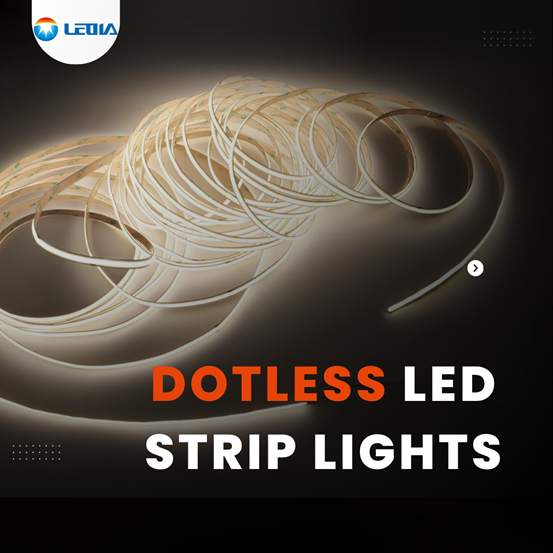
Best Dotless LED Strip Lights for Ceiling
- 9 Feb 2026
In modern architectural design, the quality of light is as important as the fixture itself. Architects, installers, and high-end clients are moving away from the harsh “dotted” look of traditional LEDs and demanding a new standard: dotless LED strip lights.
This technology creates a perfectly smooth, seamless line of light, much like a neon tube, that can be integrated directly into ceiling coves, valances, and architectural features. But not all “dotless” strips are created equal.
This guide gets straight to the point, helping you understand the technology and specify the right product for your next professional project.
Key Takeaways for B2B Specifiers
- The Best Technology: The most effective and reliable way to achieve a “dotless” look is with COB (Chip-on-Board) LED strip lights.
- Why COB?: COB technology eliminates the gaps between chips to create one continuous, diffuse light strip. It’s also more flexible and has better heat management for a longer life.
- The Pro-Spec for Ceilings: For any commercial or large-scale project, always specify 24V strips, not 12V. This allows for longer runs with no dimming (voltage drop).
- The Quality Metric: Never use a strip with less than 90+ CRI (Color Rendering Index). This ensures that textiles, wood tones, and skin tones look true and natural, which is critical in retail and hospitality.
What Are Dotless LED Strip Lights?
To get to know the solution, you first have to understand the problem.
Where Do the “Dots” Come From?
Traditional LED strips, known as SMD (Surface Mounted Diode), use individual, encapsulated LED chips soldered onto a circuit board. There are visible gaps between each chip.
When used in ceiling coves or near reflective surfaces (like polished stone or high-gloss paint), these gaps create a “dotted” or “scalloping” effect of bright hotspots and shadows. This distracting, low-quality look can cheapen an otherwise high-end design.
Dotless Solution: The COB LED Light Strip
The best way to get a perfectly seamless line of light is to use a COB (Chip-on-Board) led light strip.
COB is a newer, superior manufacturing technology. Instead of individual bulky chips, it mounts hundreds of microscopic LED chips directly onto the flexible circuit board, packing them in an incredibly dense formation with no gaps.
The entire array is then covered with a continuous layer of phosphor gel. This gel diffuses the light, converting the tiny points of light into one single, unbroken, and uniform line.
Why COB is the Best Choice for Your Cob Light Ceiling
While older SMD strips can be made “dotless” by using deep aluminum channels and thick, milky diffusers, this workaround is inefficient. Those diffusers “reduce light output”, meaning you have to buy a much brighter (and more power-hungry) strip to get the same amount of light.
Get to know: COB LED vs SMD LED: What’s the Difference?
COB technology is the specialist engineered for this exact task. It is inherently dotless and provides three key advantages for ceiling applications.
- Uniform, Glare-Free Light: A COB strip LED is “impressively uniform” on its own. It also features a very wide 180-degree beam angle, which is ideal for washing a ceiling cove in a broad, soft, and even light.
- Superior Efficiency & Reliability: The COB design, which bonds the chips directly to the board, is “better at dissipating heat”. Heat is the primary enemy of an LED. Better thermal management directly translates to a more stable, reliable, and longer-lasting product.
- Greater Flexibility: COB strips are slimmer and “more flexible” than their SMD counterparts. This is a major practical advantage for installers, allowing them to be fitted into the “tight and intricate spaces” common in complex architectural ceiling coves and custom millwork.
How to Choose the Perfect Dotless LED Strip: A Quick Guide
A successful installation depends on specifying the correct technical details. Here is what matters most for a professional ceiling project.
| Feature | Professional Specification | Ideal Application |
|---|---|---|
| Voltage | 24V (Prevents Voltage Drop) | Long ceiling runs, commercial spaces |
| IP Rating | IP20 (Indoor) / IP65 (Waterproof) | Office/Lobby vs. Kitchen/Bathroom |
| Color (CCT) | 3000K / 4000K / 6000K | Hospitality, Modern Office, or Lab |
| CRI | 90+ CRI | Accurate color and texture rendering |
Voltage: 12V vs. 24V
This is the most critical decision for any large-scale project.
- 12V COB LED Strip Light: Only suitable for very small, short-run DIY projects (less than 16 feet).
- 24V COB LED Strip Light: This is the only professional choice for ceiling applications. A 24V system can run for much longer distances (e.g., 32 feet or more) from a single power feed before suffering from “voltage drop“—the dimming effect that occurs at the end of a long run.
Environment & Durability (IP Rating)
The IP rating defines the strip’s protection against dust and moisture.
- IP20: The standard for all dry, indoor locations. This includes office ceilings, hotel lobbies, and residential coves.
- IP65: This is a COB LED strip waterproof option. It is “splash-proof” and required for ceilings in bathrooms, kitchens, or semi-open outdoor areas.
Color Temperature (CCT)
CCT defines the “warmth” or “coolness” of the white light, measured in Kelvin (K).
- 2700K – 3000K (Warm White): Creates a cozy, intimate atmosphere. Standard for hospitality and high-end homes.
- 4000K (Neutral White): A clean, modern light. Top choice for modern offices and retail spaces.
- 5000K – 6500K (Cool White): Bright, energizing “daylight.” Used for hospitals and commercial displays.
Your Partner for Seamless, Professional Lighting
Achieving a flawless, dotless ceiling requires more than just a good strip. It requires a complete system of high-quality components, from the 24V drivers specified with a 20% safety buffer to the mandatory aluminum channels that provide essential heat sinking.
At LEDIA lighting, we specialize in providing professional-grade, high-performance light strip solutions for architects, designers, and installers. Contact our lighting experts today to specify the perfect dotless LED strip lights for your design.