



-
Recessed Lighting Spacing for Kitchens and Living Rooms
Master the perfect recessed lighting layout. Learn how to space ceiling lights in your kitchen and living room to eliminate shadows and create the ideal ambiance.Read more -
4-Inch vs. 6-Inch Recessed Lighting: How to Choose the Right Size for Your Ceiling
Deciding between 4-inch and 6-inch recessed lights? Discover the best size for your ceiling height, room style, and lighting goals in this comprehensive guide.Read more -
2026 Lighting Power Density: Energy Code Compliance Path, Energy Codes (with LPD Calculator & 2026 Section 179 Calculator)
The latest 2026 Lighting Power Density (LPD) requirements. A comprehensive guide to energy codes for sustainable commercial lighting.Read more
Understanding Voltage Options for Today’s LED Strip Applications
- 19 Sep 2024
As LEDIA Lighting continues to develop professional solutions for architectural and commercial projects, we often receive questions about the common voltages used in LED lighting solutions. In our daily work, we design and supply LED light strips for diverse environments, so understanding voltage options is essential. By sharing our experience, we hope to help customers choose stable and efficient configurations that match the needs of their installations.
Voltage Types in Practical Use
When we discuss LED lighting solutions, we mainly refer to three voltage ranges: 5V, 12V, and 24V. Each option suits different project scenarios, and we guide customers based on load, distance, and installation scale. For example, 5V strips are usually chosen for short-run decorative details, while 12V is practical for medium-length layouts in retail or residential spaces. In many engineering projects, 24V becomes our recommended choice because it supports longer runs with more stable performance. Across our workflow, we notice that understanding these characteristics helps customers plan safer and more efficient circuits for their LED light strips, especially when coordinating with controllers, dimming systems, and environmental constraints.
Why 24V is Common for Engineering Projects
In professional applications, 24V remains one of the most widely selected voltages in modern LED lighting solutions. As we collaborate with engineering teams, we see the value of lower current, reduced voltage drop, and improved installation flexibility. For large commercial displays or architectural outlines, 24V helps maintain consistent brightness across extended lengths. These qualities are essential for precision-driven lighting results, and they also reduce maintenance needs. When customers choose LED light strips for outdoor façades, signage, or themed installations, 24V gives them a balanced combination of stability and efficiency. With our years of industry experience, we consider 24V a dependable voltage that meets the technical expectations of most project-based environments.
Application Example: 24V Programmable Neon Flex
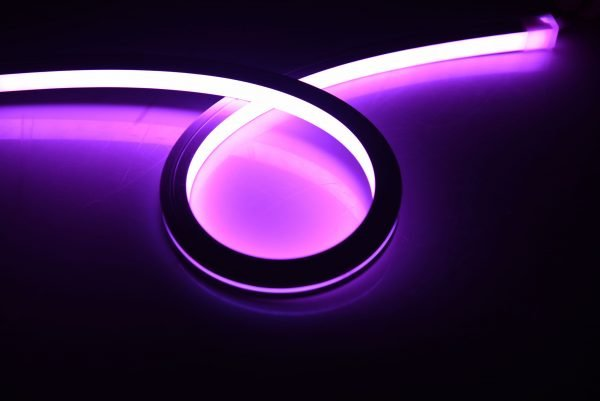
One of the products we frequently configure in 24V systems is the LD-FR-SJS-DC24V-XXXX-RGB-72-16*16mm Neon Flex (Hollow extrusion) — Programmable LED Light Strip. This model is part of our silicone-based family and is valued for its flexibility, outdoor durability, and RGB programmability. It offers cuttable design, wide-angle lighting, pure-silicone extrusion, UV and flame resistance, IP67 protection, and automated-production consistency backed with a 5-year warranty. For customers seeking creative, controllable effects in LED light strips, this option integrates smoothly into various display concepts while remaining compatible with APP-based smart control.
Conclusion
From our ongoing work at LEDIA Lighting, we understand that choosing the right voltage is crucial for reliable LED lighting solutions. Whether customers need small-scale decorative effects or large outdoor installations, selecting the proper voltage ensures safety, stability, and visual quality. In many engineering scenarios, 24V provides the balanced performance required for professional LED light strips, including programmable and weather-resistant models such as our silicone neon flex. By sharing these insights, we aim to help customers plan their projects with clarity and confidence.