

LEDIA-Smart Linear Lighting Provider LEDIA-Smart Linear Lighting Provider
2026 Lighting Power Density: Energy Code Compliance Path, Energy Codes (with LPD Calculator & 2026 Section 179 Calculator)

2026 Lighting Power Density: Energy Code Compliance Path, Energy Codes (with LPD Calculator & 2026 Section 179 Calculator)

  • 8 May 2026

Key Takeaways:

  • LPD Definition: Lighting Power Density (LPD) is the maximum lighting power allowed per unit of area, measured in Watts per square foot (W/)
  • Efficiency Gains: 2026 standards reflect a 4-5% reduction in allowable power due to increased LED efficacy.
  • Regulatory Trend: States like New York and Washington are adopting 2021 IECC or ASHRAE 90.1-2022 standards to hit carbon-neutral goals.
  • Compliance Paths: Building owners can use the “Building Area Method” for simplicity or the “Space-by-Space Method” for mixed-use precision.
  • Financial Incentives: Meeting strict LPD targets unlocks federal benefits like the 179D tax deduction.

Lighting is the “low-hanging fruit” for state regulators hitting aggressive carbon-neutral goals. Because lighting typically accounts for a significant portion of a commercial building’s energy use, reducing the allowable lighting power density is the fastest way to lower a city’s carbon footprint.

For LED professionals, moving from “compliance as a burden” to “efficiency as a competitive advantage” is key.

What is Lighting Power Density (LPD)

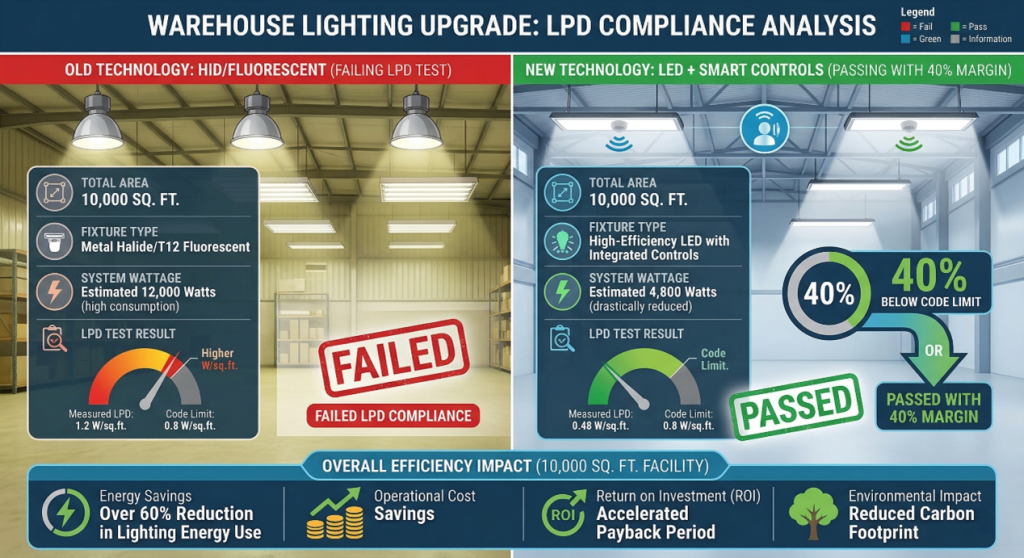
Lighting Power Density (LPD) is a metric used in building codes to limit the amount of electric power used for lighting in a specific area. It is calculated by dividing the Total System Wattage of all lighting equipment by the Gross Lighted Floor Area of the building or space.

How to Calculate LPD Value?

To calculate LPD, you must account for the total input power of the entire lighting system, including the power consumed by LEDs and their drivers.

LPD = Total Lighting Power (Watts) / Gross Lighted Floor Area (sq.ft.)

Using high-efficacy fixtures allows designers to maintain high light levels while staying under the strict wattage caps mandated by 2026 codes.

Lighting Power Density (LPD) Calculator

LPD Calculator
Lighting Power Density Formula
Total Lighting Power 3,000 W
Calculated LPD
0.75W/m²
Residential / Local Street

Moderate lighting. Perfect for neighborhood streets, balancing pedestrian safety with energy efficiency and minimizing light pollution.

Which Energy Code Compliance Path is Best for You?

Based on U.S. Department of Energy (DOE), choosing an energy code compliance path depends on your project’s complexity, design goals, and specific local requirements (such as California Title 24 or IECC/ASHRAE 90.1).

Here is an accurate protocol to help you decide which path to choose.

1. Determine Your Compliance Methodology

Energy codes generally offer three primary paths to demonstrate compliance. Your choice should balance ease of calculation with design flexibility.

Prescriptive Path:

You must meet every individual requirement specified in the code (e.g., minimum R-values for insulation, specific window U-factors, and maximum Lighting Power Density).

It is mainly used for simple buildings or projects where the design already aligns with standard code values. It is the “checklist” approach.

Trade-Off Path (e.g., COMcheck/REScheck)

Allows you to “trade” performance between different components. For example, you can use less efficient windows if you install more efficient insulation.

Best for projects that fail one prescriptive requirement but exceed others. This path uses software to verify that the total “UA” (U-factor x Area) of the building is equal to or better than the code’s baseline.

Performance Path (Simulated Energy Performance)

Uses whole-building energy modeling software to simulate annual energy use.

Mainly for complex or high-performance buildings, projects with significant glass areas, or innovative designs that don’t fit into standard categories. It offers the most flexibility but requires the most documentation.

2. Select Your Lighting Compliance Method

For lighting specifically, some study outline two sub-paths for calculating Lighting Power Density (LPD), the amount of power used per square foot:

Complete Building Method

Assigns one single LPD value (e.g., 0.65 W/ft² for a retail store) to the entire building. It is best for single-use buildings (like a standalone warehouse or retail shop) where the lighting is uniform throughout.

Area Category Method

Breaks the building down into specific space types (offices, hallways, storage), each with its own LPD allowance. This method can be used for multi-use buildings (like an office complex with a cafeteria and gym) to gain more “lighting credit” for specialized areas.

TL; DR: LPD Suggestion for Your Commercial Lighiting Project

If your project is... Choose this Path Why?
Small & Simple Prescriptive Minimum effort; no specialized software needed.
Slightly customized Trade-Off (UA) Allows flexibility in materials (e.g., better insulation for more windows).
High-Performance Performance Necessary for LEED certification or extreme energy efficiency goals.
Uniform Lighting Complete Building Fast calculation based on total square footage.
Diverse Lighting Area Category Maximizes allowable wattage by tailoring limits to specific tasks.

Why Do Energy Codes by State Vary So Wildly?

Energy codes vary because each state chooses which version of the International Energy Conservation Code (IECC) or ASHRAE 90.1 to adopt. While some states use older 2015 standards, others like New York and Washington are early adopters of the more stringent 2021 and 2024 updates.

States with aggressive climate legislation, such as the New York State Energy Code and the Washington State Energy Code, often skip older versions to implement the latest efficiency requirements.

  • Leading States: These are currently enforcing 2021 IECC or ASHRAE 90.1-2019/2022 standards.
  • Developing States: Many “Red States” are currently moving toward the 2018 IECC standards.
  • Local Control: Cities like Austin, TX or Seattle, WA often implement local amendments that are even stricter than their state’s baseline code.

What are the LPD Limits for Different Building Types?

LPD limits are determined by the primary function of the building. For 2026, most commercial offices must stay below 0.61 W/f2, while warehouse are capped at 0.7W/f2

Building Type Older Codes
(IECC 2015)
Current National
(ASHRAE 90.1-22)
California
(2025/2026 Title 24)
Office 0.82 W/ft² 0.64 W/ft² 0.65 W/ft²
Retail 1.26 W/ft² 0.84 W/ft² 0.90 W/ft²*
Warehouse 0.66 W/ft² 0.45 W/ft² 0.40 W/ft²
School 0.87 W/ft² 0.72 W/ft² 0.60 W/ft²

*Based on the Building Area Method.

What are the Requirements for Exterior Lighting?

Exterior LPD is governed by “Lighting Zones” ranging from 0 to 4. Zone 1 (Rural) has the tightest restrictions to prevent light pollution, while Zone 4 (High Activity) allows for higher power density to ensure public safety.

What Financial Incentives are Available for High Efficiency?

The industry direction is clear: lighting codes will only get tighter. To avoid the cost of retrofitting every three years, you should design the lighting systems for 10-15% below the current 2026 code.

Designing to the “minimum” code requirement today often means falling out of compliance by the next update cycle.

High-performance LED solutions provided by LEDIA Lighting ensure your building remains an asset.

How to Future-Proof Lighting Designs?

Meeting lower LPD targets unlocks the 179D Tax Deduction, which provides building owners with a deduction for systems that significantly exceed ASHRAE standards. When combined with utility rebates, the payback period for a high-efficiency LED installation is dramatically reduced.

2026 Section 179 Calculator​

Financial Incentive Guide

The 179D Commercial Buildings Tax Deduction

Offset your commercial lighting upgrade costs. Discover how much you can claim per square foot and the exact pathways to qualify.

How Much Can You Claim?

Standard Deduction
Meets 179D Energy Criterion Only
$0.58 – $1.16
per sq. ft.
Maximum Value
Bonus Deduction
Meets Energy + Prevailing Wage & Apprenticeship
$2.90 – $5.81
per sq. ft.

Tax Deduction Estimator

35%
Estimated Deduction
$203,000
Based on $4.06 per sq. ft.

Who Can Claim the Deduction?

Commercial Building Owners

The standard taxpaying entity that owns the eligible energy-efficient property (like your newly upgraded lighting system) placed in service.

Designers & Contractors

The primary designer or contractor can claim the deduction if it is officially allocated to them by a tax-exempt entity (e.g., public schools, government buildings).

How to Claim: 2 Compliance Pathways

1

Traditional (Modeling)

Best for new construction and standard building upgrades.

Uses building energy simulation software to prove savings.
Measures modeled energy & power cost savings against an ASHRAE baseline.
2

Alternative (Measurement)

Best for retrofitting older buildings (placed in service 5+ years ago).

Uses actual, measured energy consumption data.
Measures site Energy Use Intensity (EUI) before and after upgrades.

Ready to maximize your savings?

Our experts can help you design a high-efficiency lighting layout that qualifies for the maximum 179D deduction.

Discuss Your Lighting Project

Ready to Future-Proof your Next Project?

LEDIA Lighting provides high-efficacy LED solutions specifically engineered to exceed 2026 LPD requirements. Explore our Linear LED and Industrial Solutions here.


Leave a Reply

Your email address will not be published. Required fields are marked *

Get In Touch

Get In Touch