

LEDIA-Smart Linear Lighting Provider LEDIA-Smart Linear Lighting Provider
Recessed Lighting Spacing for Kitchens and Living Rooms

Recessed Lighting Spacing for Kitchens and Living Rooms

  • 9 May 2026

Key Takeaways:

  • Divide your ceiling height by two to determine the baseline distance between your recessed lights.
  • In kitchens, position lights exactly 12 inches from upper cabinets to prevent casting shadows on your workspace.
  • Living rooms require wider spacing (5 to 6 feet) and an 18-to-24-inch perimeter wash to make the space feel larger.
  • Base your layout on foot-candle targets: kitchens require 50–70 foot-candles, while ambient living areas require much less.
  • Always adjust your final spacing to account for the fixture’s beam angle (typically 40° to 120°) to avoid hotspots or dark corners.

The golden rule for recessed lighting spacing is the “Divide by Two” formula: simply divide your ceiling height by two to determine the ideal distance between each light.

For example, an 8-foot ceiling requires spacing lights 4 feet apart.

However, while this recessed light coverage rule provides a strong baseline, professional layouts must also adjust for beam angles (typically 40° to 120°) and specific room functions.

This guide breaks down exactly how to calculate and execute the perfect lighting layout for your kitchen and living room. This blog will also provide interactive spacing calculator to facilitate your measurement. Scroll down to learn more!

How Do You Calculate Recessed Lighting Spacing in a Kitchen?

To execute proper kitchen recessed lighting placement, focus on illuminating the countertops without casting shadows. That is, to position your general ceiling lights 12 inches away from upper cabinets, and space high-output task lights approximately 3 feet apart over islands.

The 12-Inch Rule for Countertops

When you stand at a counter to prep food, a light placed directly behind you in the center of the walkway will cast your shadow over your cutting board.

To prevent this “shadow effect,” position the center of the recessed light exactly 12 inches out from the face of your upper cabinets. This ensures the light cone hits the center of the countertop directly in front of you.

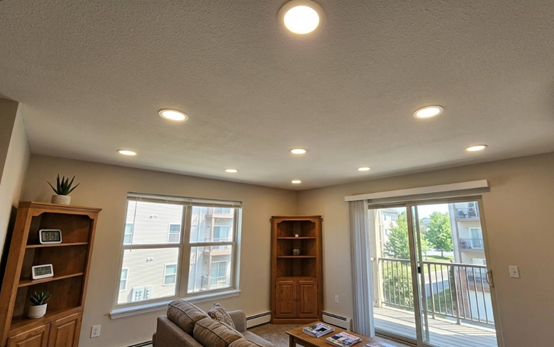
Kitchen countertop lighting design

Island Focus and Task Lighting

Kitchen islands require intense, focused task lighting rather than general ambient light. We recommend using 4-inch, high-output LED fixtures spaced closer together, typically 30 to 36 inches apart. This ensures the entire prep surface is evenly illuminated without creating blinding glare for people sitting at the island.

👉 Click to learn: a complete explanation, with LPD calculator and Tax 194 Reduction Estimation

Layering with Under-Cabinet Lights

Recessed lighting should never do all the work in a kitchen. For the ultimate shadow-free workspace, layer your ceiling lights with high-quality under-cabinet illumination.

LEDIA lighting Needle G01 Series is specifically for this purpose. This ultra-slim, 24V single-color temperature linear fixture provides continuous task lighting directly over your prep zones, operating completely hidden from view.

What is the Best Recessed Lighting Spacing for a Living Room?

The best living room layout avoids a symmetrical grid, utilizing a wider spacing of 5 to 6 feet between fixtures. Position the lights 18 to 24 inches from the walls to create a “perimeter wash” that visually expands the room.

Avoid the "Swiss Cheese" Ceiling

Professional lighting designers strongly advise against slapping a rigid, symmetrical grid of lights across a living room ceiling. This approach is often referred to as a “Swiss Cheese” ceiling; it washes out the room, flattens the architectural details, and destroys the relaxing ambiance expected in a living space.

The Perimeter Wash Technique

Instead of lighting the floor, light the walls. By placing your fixtures 18 to 24 inches away from the wall and spacing them 5 to 6 feet apart, you “wash” the vertical surfaces with light. This technique reflects light back into the center of the room and visually pushes the walls outward, making the entire space feel larger and more inviting.

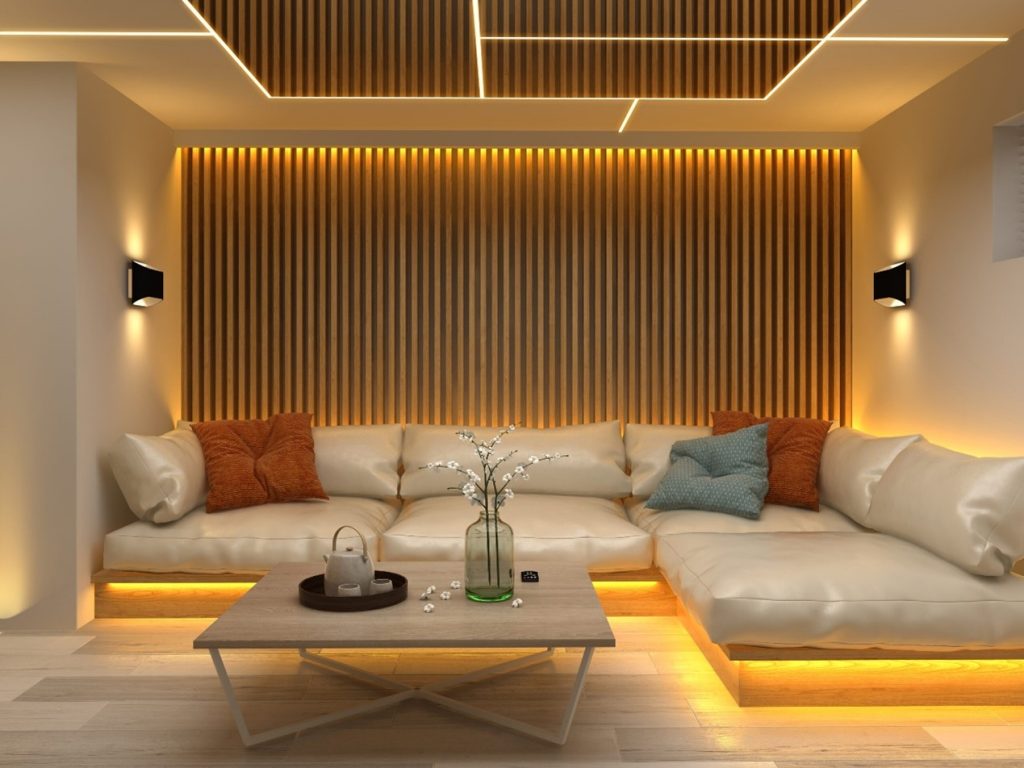
living room lighting design with led strips for recessed lighitng design

Zoning with Dimmers

Always group your living room lights into distinct zones on separate dimmer switches. This allows you to brighten the main seating area for a family gathering while keeping the perimeter accent lighting soft, giving you total control over the room’s mood.

Why Do Lumens Matter More Than Watts for Spacing?

Spacing depends entirely on Luminous Flux (Lumens) and the fixture’s Beam Angle, not the energy it consumes (Watts). Understanding your target foot-candles ensures you install the correct number of lumens to achieve the necessary brightness for the room’s specific function.

Watts vs. Lumens

A watt measures electricity usage, while a lumen measures actual light output. When determining your layout, you must use lumens to ensure adequate coverage.

Two fixtures might both use 12 watts, but one could output 800 lumens while the other outputs 1,100 lumens, fundamentally changing how far apart they can be spaced.

Meeting Foot-Candle Targets

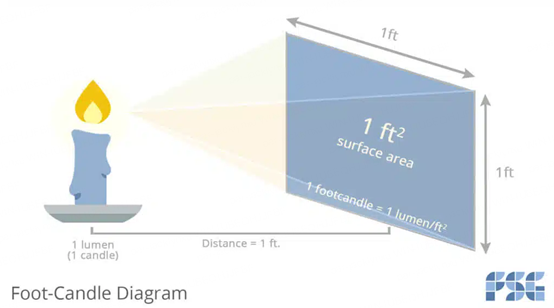
A foot-candle measures light intensity hitting a specific surface. According to industry standards, a high-task area like a kitchen requires roughly 50 to 70 foot-candles on the work surface.

If your fixtures have a narrow beam angle (e.g., 40°), you will need more lumens and tighter spacing to hit this target compared to fixtures with a wide 120° flood beam.

A foot-candle measures light intensity

Source: FSG

Frequently Asked Questions About Recessed Light Coverage
Proper installation requires precise distances from walls and understanding how ceiling height interacts with beam spread to avoid dark spots and harsh shadows.

As a general baseline, place your lights at a distance equal to 1/3 to 1/2 of the space between the lights themselves. If your lights are spaced 6 feet apart, they should be 2 to 3 feet from the wall.

Spacing lights too far apart creates "The Cave Effect." This results in dark, unlit spots at eye level between the cones of light, making the room feel gloomy, uneven, and poorly designed.

For a 10-foot ceiling, 4-inch fixtures are excellent for targeted task lighting over the island, provided they have a high lumen output and a focused beam angle. However, because light dissipates over distance, 6-inch fixtures with wider beam angles are generally more effective for the ambient lighting layer to ensure the light reaches the floor without pooling.

Getting your recessed lighting spacing right is the foundation of a beautiful, functional home. By applying the "divide by two" rule, respecting the 12-inch countertop distance, and calculating your lumen requirements, you can achieve professional-grade results that elevate both your kitchen and living room.

Ready to design your ceiling layout? Explore LEDIA lighting’s advanced architectural LED solutions. Fill in the blank below to contact our engineering team today for expert guidance, spacing recommendations, and project-specific support.


Leave a Reply

Your email address will not be published. Required fields are marked *

Get In Touch

Get In Touch